
Our numbers
What our video engine has made so far
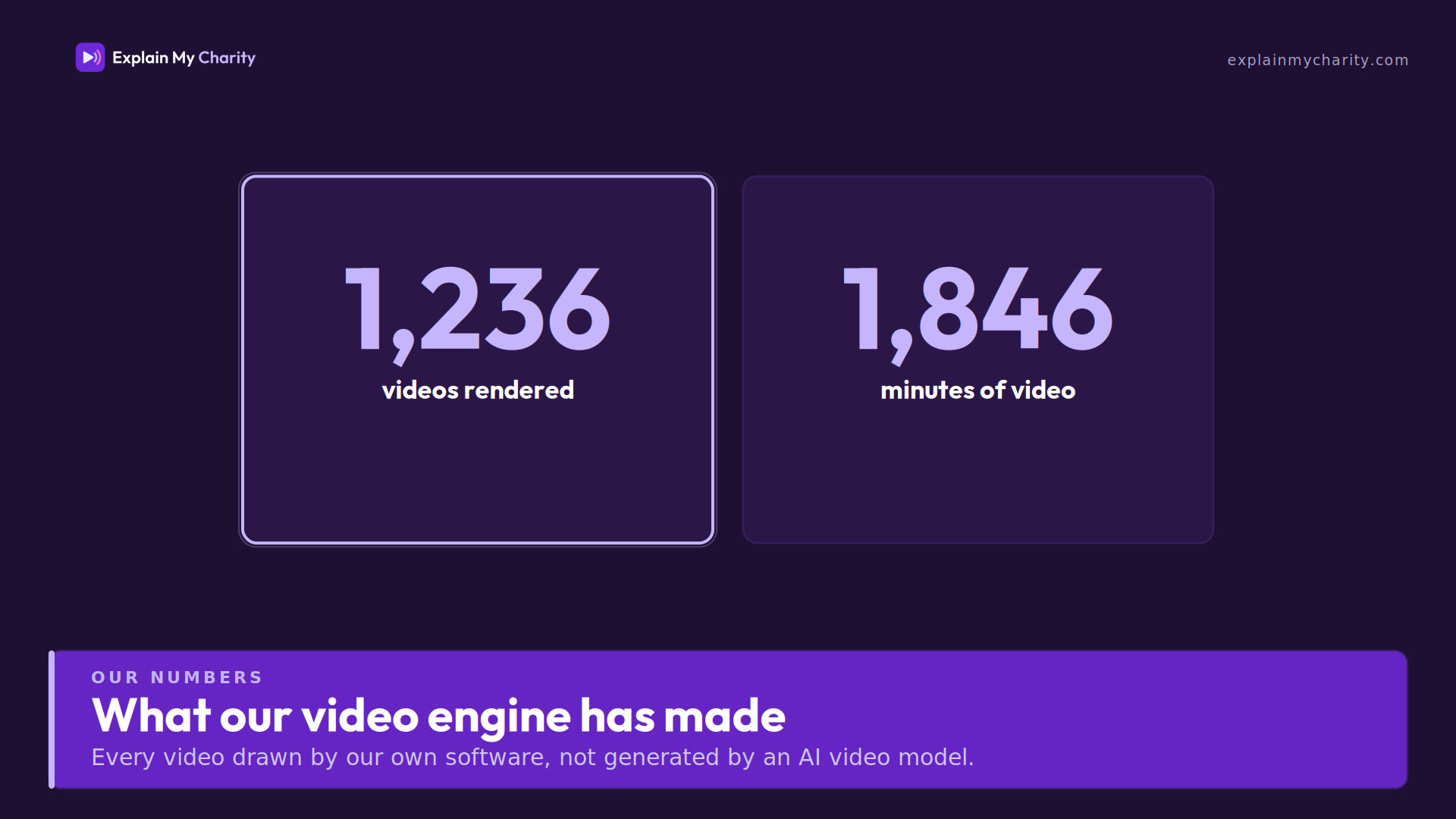
Every Explain My Charity video is drawn by our own software, not generated by an AI video model. Our engine also makes the videos of our sister services, so these are the figures for all of them, counted from the videos themselves on 4 October 2026.
Our engine has rendered 1,237 videos (1,847 minutes). Making them with an AI video model instead would have used an estimated 710 kWh more electricity and about 12–44 kg more CO2e (our central estimate, from the UK grid average to our electricity supplier's stated mix), our own AI drafting included. How we estimate it.
Key numbers
- 1,237videos rendered
- 1,847minutes of video
- 710 kWhless electricity than an AI video model, estimated
- 12–44 kgCO2e avoided, estimated: UK grid average to our supplier's stated mix
- 50–90 Whelectricity for a whole 70-second video, its AI script drafting included (measured, September 2026)
Estimates against an AI video model, our own electricity taken off first. How we estimate them.
How we estimate the electricity
- The alternative we compare with: one take of AI-generated footage for each version of each video from an open AI video model, run on the same computer as ours and measured in September 2026.
- Conservative on purpose: we assume the AI video model gets every version right first time, with no retakes; we use its lowest measured rate and the top of our own range; and a Short cut down from one of our videos counts as no saving at all.
- Our own footprint is taken off first, counting drafting every version's script with an AI language model as a whole working session of its own, and rendering everything we rendered, including the takes we later replaced.
- Not included, on either side: training the AI models, making the hardware, streaming the videos, and people's time.
The month-by-month charts, the carbon factors and the method in full are on explainapaper.com/our-numbers, where the count is kept (method version 3.0.0).
Against a traditional animator: an estimate
Estimated, from published studio guides, not measured. Studio guides put a one-minute 2D animated explainer at 40 to 140 hours of skilled work. On an office workstation, at the UK government's figure of 150 watts, that is 6 to 21 kWh of electricity. One of our 70-second videos takes up to two hours of our staff's time and an estimated 0.2 to 1 kWh in all, counting the AI that helps draft the script as a whole working session. So even our highest estimate uses at least 6 times less electricity than the studio's lowest.
On price, a video is £39 before VAT, and UK animation studios' own price guides put a 60 to 90 second explainer in the thousands of pounds (how we compare).
The assumptions: 40 hours is the lowest published figure for a minute of 2D work, before revisions, and 140 hours the top of the basic tier; premium work takes longer. The workstation figure is the one the UK government uses for an office computer, screen and printer. Travel, heating, a voice-over studio and your own time are left out on both sides. Hand animation is a different product, with a storyboard you shape and a human voice.
What this does not mean
Our videos still use electricity, and so does the AI that helps write their scripts. These are estimates of electricity not used compared with one alternative, not a claim that our videos have no impact. The footage an AI video model makes also could not show your document's text, data or charts, which is why we draw ours in code. For where AI is and is not used in a video, see AI and ethics.